Political Advocacy for School Librarians by Ann Dutton Ewbank & Kathi Kromer
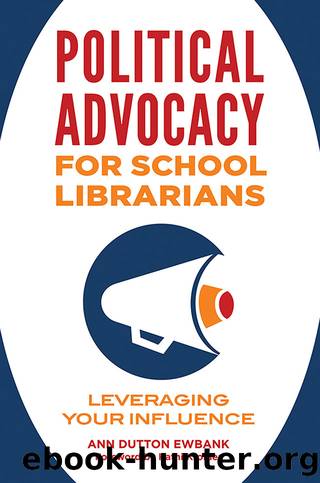
Author:Ann Dutton Ewbank & Kathi Kromer
Language: eng
Format: epub
Publisher: ABC-CLIO
Working with the Executive Branch
The state executive branch consists of the Governorâs office and various agencies charged with executing government functions. The Governor is the stateâs chief executive officer and is charged with implementing state law and providing oversight for state agencies. The Governor also creates a budget proposal for consideration by the legislature and nominates individuals for judicial and executive appointments. The Governor has veto power in the legislative process and can issue Executive Orders, or directives, within the scope of his or her authority. Governors can also employ selected powers in the event of an emergency such as a natural disaster or catastrophic event (National Governors Association 2018).
State agencies administer the laws enacted by the legislature under the direction of the Governor. State agencies, through established representative boards and councils, determine the administrative enactment of the laws. State laws (also called statutes) are accompanied by a compendium of administrative rules, which are also called codes or regulations (see http://www.administrativerules.org/administrative-rules/). Administrative rules are extremely important to state governance, as they are essentially the detailed blueprints of how the laws are enacted. Administrative rules exist because as conditions change, the application of the law may also need to change.
Typically, each state agency has a Governor-appointed board or commission consisting of both at-large and representative members. These boards make decisions about administrative rules for their respective agencies. State agency boards can propose, amend, or repeal administrative rules within the scope of the law or change or repeal these rules as laws change. There is usually a public comment period and hearing prior to the rule-change vote. State agencies may also establish negotiated rulemaking committees consisting of agency representatives and representatives of advocacy groups or institutions. In a series of public meetings, negotiated rulemaking committees attempt to reach consensus on an administrative rule. If consensus is reached, the proposed rule is voted upon by the state agency board. If consensus is not reached, the process begins again. Ultimately, the board determines the administrative rules for its agency. While agency boards are not elected officials, they wield considerable influence over the administration of laws. Identifying and doing background research on state agency board members is very important for successful political advocacy.
Download
This site does not store any files on its server. We only index and link to content provided by other sites. Please contact the content providers to delete copyright contents if any and email us, we'll remove relevant links or contents immediately.
| Anthropology | Archaeology |
| Philosophy | Politics & Government |
| Social Sciences | Sociology |
| Women's Studies |
Cecilia; Or, Memoirs of an Heiress — Volume 1 by Fanny Burney(32654)
The Great Music City by Andrea Baker(32621)
Cecilia; Or, Memoirs of an Heiress — Volume 2 by Fanny Burney(32025)
Cecilia; Or, Memoirs of an Heiress — Volume 3 by Fanny Burney(32005)
We're Going to Need More Wine by Gabrielle Union(19121)
All the Missing Girls by Megan Miranda(16411)
Pimp by Iceberg Slim(14713)
For the Love of Europe by Rick Steves(14659)
Bombshells: Glamour Girls of a Lifetime by Sullivan Steve(14152)
Talking to Strangers by Malcolm Gladwell(13474)
Norse Mythology by Gaiman Neil(13472)
Fifty Shades Freed by E L James(13306)
Mindhunter: Inside the FBI's Elite Serial Crime Unit by John E. Douglas & Mark Olshaker(9447)
Crazy Rich Asians by Kevin Kwan(9360)
The Lost Art of Listening by Michael P. Nichols(7568)
Enlightenment Now: The Case for Reason, Science, Humanism, and Progress by Steven Pinker(7369)
The Four Agreements by Don Miguel Ruiz(6852)
Bad Blood by John Carreyrou(6684)
Weapons of Math Destruction by Cathy O'Neil(6388)
